Showing posts with label #needsofindividuallearners. Show all posts

Monday, 28 January 2019

Unpacking the matrix on LCS at HHS

Staff were presented with the matrix we are measuring ourselves against.

It was an interesting exercise to complete and I'm still not finished. From within it, I was able to generate two more goals to work on in our practice in visual arts, and it also gives me something to work with our staff in aligning practice.


What I really liked about this exercise is that it was a way of quietly starting off each learner's mindset with LCS again, it was non-confrontational and we could set our own pace. 

I would like to have spent more time with the solo stuff at the start, but this does give us the scope to go back to SOLO and LCS midterm perhaps. 


Sunday, 30 April 2017

Breakdown of Scholarship Begins...

Scholarship resources for Hornby High School starting here.

Late last year, I overheard a conversation between two teachers about how we 'need' a separate class for scholarship potential students at year 13. According to the vocal one of the two, this class would be about 5 students. The school's Senior Leadership Team needed to prioritise it if they really care about students succeeding here and yes that would mean academic casualties, like the loss of some subjects or pass rates to achieve it. It was seen by one of the two as the only feasible way to break the spell and get those elusive scholarship grades. The other stayed very quiet.

This idea that you have to be in the right class is no different to having to be in the right school, live in the right area, come from the right two-parent family with the right moderate to good income, driving the right car... Nothing of it sits well with me. I rage inside at the thought of it. I want Cinderella to go to the ball, Dorothy to find home and Snow white and Sleeping Beauty to get themselves up out of bed.

We already had our one student sitting her scholarship and we knew she was well on track for the excellence required to be able to be considered for it. Not once did I consider that anyone else had, or should have to miss out on their place in the class because of her. Or, in order for her to get there that they should go. But that was definitely my moment of 'we are going to make this real here'.

So we are paving that yellow brick road, making it real and breaking the spell. The significant things I have found are that the way it is assessed is not terribly similar to the boards or the other standards.

There are three categories that they assess by and the students can achieve three different grades of not achieved. Each category is marked out of 8. 24 marks in total are attainable. It's complexity can be very daunting when resilience is a key component requiring significant scaffolding. The link above is the document for assessment. It is posted on our google site and students are able to find it and comment on it if they wish. I would be encouraging students to use this to seek clarification if they need it.

The resources online are limited in comparison to other standards. Not many schools like sharing! Though one has been very generous in his Teaching Inquiry on scholarship and his resourcing. Tim Thatcher at it has certainly made it all very much clearer in how this could be handled within an average class. I see from his inquiry, that total integration within a classroom is preferable to having separate classes or sessions outside of class devoted to scholarship. That the uptake for those dwindled as the year carried on.

What I have achieved so far:
- We have one certainty for scholarship in both Design and Paint (willingness that is, though exceptional talent too) for 2017
- There are students in our current 2018 year 13 cohort who need to be considering this exam also, but there are also a lot of pressures on high school students. How far do we go in preparing students for this? Or is that no better than the 'right' class, right school scenario?
- Breaking down scholarship to be less complex and visible to the students on the main google site for Art at HHS.

Still working on:
- Having some kind of calendar for the 8 pages (which I would want to say were 12 so that students could edit them down to the best 8)
- Accessing a range of schools resources, including sharing what I have done without feeling like a poor cousin. Walk the talk. Sigh.
- Using Art History standards to better allow for that research component. It is really successful in level one so far this year... I have an unpublished blog post about that come to think of it...
- Using Classroom, Hapara, blogging or something to work the critiques through with the individuals as they go along for the scholarship pages. Will discuss with colleagues.
- Making a 24 hour day into a 30 hour one.


Wednesday, 1 March 2017

2017 Inquiry


Our Inquiry for Visual Arts this year is a joint one, focussing on how best to spread the load of specialty skills across as many senior students as possible.

Can Teacher Collaboration Improve Student Achievement in Senior Art Classes?

Our progress so far has been to set up the google sheets to track at least the first 6 weeks of each class in the senior school for Art. I would expect these to develop and grow based on how we use them.

There is the intention that these are used to make sure no student is left behind in being given feedback and kept up to speed.

We have also organised to split up the line 3 and 4 classes and share the teaching across those lines. We do have differing styles and expectations so it may take a little time to adjust to this. however, if students are truly working to their own goals and are there for the right reasons, this should come together.

At this point in time we have one over subscribed class of 37, one of 33, one of 13 and one of 22. Because we chose to mix our levels, there was a lack of communication between the three levels in general about numbers, so this is an issue that needs clarifying.

By the end of 2017, I want to be able to say we gave every senior student the best possible chance with teacher expertise available to direct their own learning. I want every student to be able to direct their own learning, rather than lean on the teacher or dismiss their own chances because the right teacher is not there.


Friday, 23 December 2016

Wednesday, 12 October 2016

ULEARN 2016

Thank you Spark and MIT for this opportunity.


 notes accompanying the slides:

Slide 1 - Tēnā Koutou Katoa Ko Kaiterau tōku Māunga Ko Waikōau tōku awa No Kaikoura ahau Ko Annette rāua ko Paul Bourke ōku mātua Ko Rowena Clemence tōku ingoa

Slide 2 - He Kaiako Te Huruhuru Ao o Horomaka Nō reira, tēnā koutou, tēnā koutou, tēnā koutou katoa. Welcome to my presentation as a Visual Arts teacher at Hornby High School in Christchurch. 

Slide 3 - We have new tools requiring new pedagogy that allows learning to happen ubiquitously, rewindably. Teachers dream of facilitating learning rather than ramming knowledge down throats to be regurgitated later. We have an opportunity for self-efficacy.

Slide 4 - ‘Why’? Woolf Fisher data from 2016 highlights the problem we knew we already had with writing. 72% of our new entrants into year 7 are below or well below the national standards in writing. The problem is not the ‘dumbness’ of our kids, as they are not.

Slide 5 - It is the skill-set to break up language and reapply it. People with good writing skills are generally seen as more credible. Are our students equitably empowered when they are constantly playing catch-up with national standards in writing?

Slide 6 - There are no ministry exemplars in Art for the junior levels. Art teachers apparently ‘just know’. Equal emphasis and weighting is on all four strands. Two of these strands require written/vocabulary based understanding.

Slide 7 - So I’m look at Writing. Understanding key words so they can use them effectively. Compare their work to what they understand of the curriculum, assess, plan their next steps. How do we manage this ubiquitously? And in a way that supports learning beyond Art?

Slide 8 - If the students have the words, they control their learning. When they don’t have the words, it’s easier to talk one on one and watch you understand (there is a certain amount of reading your reactions going on) natural intuition and intelligence.

Slide 9 - Every child I surveyed returned a low self-rating of curriculum level. Most children surveyed demonstrated they didn’t understand that visual Arts had curriculum levels. We are doing everything as a school to address this stuff.

Slide 10 - So much we get confused, and it all comes from the one place of wanting to do our very best for our students, to undo the deficit theorising, social expectations, social issues that affect their daily lives.

Slide 11 - I had to move from how I have always done stuff to making it ubiquitously accessible. SAMR is clear measure for me to assess my own teaching methods against. This was not an overnight success. It was a gradual realisation based on the pedagogy driving it.

Slide 12 - I tried this. Over-complicated, too many words, I am an experienced teacher, but I still do not know much about teaching at year 7 and 8. Clearly. I had a whole class complete these and basically i told them the answers as they went.

Slide 13 - These are matching exercises. I broke those strands into keywords for level 3 of the NZC. Then it became obvious that I could use it more than just as a substitute for flash cards. A bank of learning cards could be created. With work on them.

Slide 14 - We have recently started to refer to these as ‘delete it’ exercises. In modifying the task, google draw was a pretty simple tool. I picked a year 7/8 class that I was only getting once a week, choosing to focus on understanding over doing.

Slide 15 - I figured I may as well see if I could extend their literacy over their practical skills in the time I had. Initially we used smart share on Hapara to send these out and a whiteboard to organise who had done what...but the whiteboard was always erased next time, and it was messy.

Slide 16 - More modification was required Drives were cluttered and students were not yet working on wholistic blogs. Hapara WORKSPACE allows for a cleaner interface and embeddable in the google site for Art. It changes this into something much more ubiquitous too.

Slide 17 - I can grade it and send the students feedback. Students who have arrived late to the class can be included in all prior learning. I can see when a student misunderstands their work, they can save their work as jpegs and upload them to their now functioning blogs.

Slide 18 - Beyond this, what is good and not so good, at each level? Using google sheets, I have made self-assessment sheets; rather than students guessing what ‘good’ looks like. I ‘know’ what it looks like without much ministry guidance, but still it needs to be carefully quantified.

Slide 19 - This is shared with all the students in their class. They can only edit their named row. Each row is locked down to only that student. They can see each other’s assessments for their work, but they cannot change it. It is coded to achieved, merit, excellence.

Slide 20 - So what can my students do now that they couldn’t do before? The students in this particular class can explain there are 4 strands, that they feel they are within level 3 because they can see it. An autistic boy does his work at home away from class, and that is fine. I can see it.

Slide 21 - This is where I want to take this next. In doing this, I will be working alongside our local primary school and another, to determine how Visual Arts is handled within a teaching programme, at the same time using this as an opportunity to refine project based learning skills for my own use.

 Christina Fortes, just for you.

Sunday, 7 August 2016

"Write That Essay" PLD day notes

Our focus is writing and based on the Woolf Fisher data we received on Wednesday, That is pretty much what it should be.


There were a lot of useful tips and tricks that we can implement starting Monday, and we will. Blog posts are about to change for our senior students.

Monday, 1 August 2016

Language Accessibility Again

DI***********.jpgWhat worked DI.jpgUse artist model DI.jpgAnnotations DI.jpgDI************.jpgDI**************.jpgMeaning DI.jpgBeauty in your mistakes DI.jpgDI*******************.jpgDI*****************.jpg

From this,


to this...


This does work, but, man, the language is hard in the CI and UC strands for them. A lot of repetition is needed. And some definitions still need tweaking.

Not all of the words are straight from the curriculum statements. In each strand I have included words I teach to, and have taught to. For example 'Tache' in PK.

Next steps; 
- Starting at a level below what I think they are
- Building up a cache of language google drawings that they 'get' quickly and can start to show some fluency in,
- Applying the words to their own and others pieces of Art pieces and building a communal bank.
- Making this accessible to other teachers to start using and add to.
- Measuring student's performance from starting to finishing and within curriculum work over the year. Using self-assessment as well as teacher based assessment.
- How does this link into SOLO and how I am re-structuring units of work around Learn, Create, Share.

Monday, 30 May 2016

7 BK SPARK MIT trial with google drawing 'cards'

Learning outcome; Understanding the Visual Arts strands at Level 3 of the NZC

Objectives:
- To be able to recognise explicitly what is required in meeting each strand
- To be able to figure out what is potentially missing in a piece of work within each strand
- To be able to negotiate their own strengths and weaknesses in their own work based on this breakdown of understanding

What we want to achieve because of this:
- A bank of resources that demonstrate understanding of each strand, within potentially the same piece of work
- To be able to differentiate not only between curriculum levels, but also between a low, mid and high standard in each curriculum level
- To be have an open, accessible and collaborative bank of student work that can be used in self-assessing, comparison and idea gathering for other teachers and students beyond Hornby.

What I have so far:
Level 3 Practical Knowledge;

We used a piece of work from another class that was incomplete, but clearly demonstrated this strand, at this level and in the unit of work this particular class is just finishing up. Verbally, students could easily identify everything I wanted them to be able to see. However, translating my intentions and their answers from a verbal conversation to the google drawing 'card' I made was more challenging. I have not taught this age level before. I over-construct sentences at the best of times. For 10 and 11 year olds, it must be terrifying. Working on the chrome books is significantly different to my laptop, which meant that we had some technical challenges, however, 7 bk were remarkably prepared to continue trying out 'how' to do this right. Eventually, we go t a good number of cards completed and saved.

What I am doing differently next time:
- Working on defining the strands in clearer and more simplidied language than last time.
- Using a chrome book as my teacher's computer, so I am in the same place as the students.
- Simplifying the language used on the google drawing 'card'.
- Use CARR awards more regularly during the lesson - no one seemed to notice, but it is a school system and I should have used it.

What I am happy about:
- It sorta worked
- The resilience of 7bk is awesome
- Their digital citizenship was on point - no off task behaviour on chrome books
- I can see this taking shape (just slowly) and a good positive direction.
- I can see how I could integrate the google self assessment sheet I have already worked on, with this; self-efficacy has to be an outcome of that approach in my opinion.
- I have found an educationally sound and useful way of working with google drawings - I initially just thought they were too basic to be of use with teaching something like Design and not relevant to anything else. I have changed my mindset, and solutions have presented themselves.

Wednesday, 25 May 2016

SPARK - MIT trial

7 Bk's Class blog.

This is a class I have hardly seen and they cannot keep up with the programme we had initially planned on because of that. Interruptions will continue unfortunately, so I am going to work with them as a trial class.

I will post up the results of this after Thursday

Monday, 16 May 2016

SOLO in Art

This is our take on SOLO with Visual Arts. It fits cleanly with our base assessment scale, with the expectations of NCEA in visual Arts at level 1 - 3 and as a way to enable good clear scaffolding for students to achieve at higher levels too.


SAMR - Not a Hierarchy

Above the line and below the line is often how it is referred as, but as soon as you do that, it becomes something that has a finish - when you get to redefinition, you can go no further until someone invents a new app...

This approach negates the fact that there is good teaching and bad teaching, good learning, bad learning with or without technology. Sometimes a substitution task is the most appropriate for the learner in front of you. Sometimes you move from redefining a task back down to substituting a section of it with a google doc, for good reason; the best for the learner's needs at the time.
While what we want is for students to be determining their own learning, that is not always possible, nor what we need at the time. The idea that if we are teaching to the needs, and students are learning what the need to know, we are moving above and below the line all the time.


Wednesday, 11 May 2016

Student self assessment - Qualitative Data gathering using google sheets

Spark - MIT have given me the opportunity to explore and figure out a way of developing a way with my students to unpack the curriculum in Visual Arts for themselves. In order to do this successfully, (shoutout Tania Coutts for help with this) I need them to be able to not only self assess, which they do anyway, but to be public and brave about it.

Google sheets is essentially 'live'. 'Protected sheets and ranges' means that I can have multiple editors and lock them down to only what I want them to be able to edit. Qualitative data is significant in understanding how students are managing that top end of the curriculum.

This is where we are at with all of our junior classes. Because it is all of them (13 classes in all) it is a bit of a Himalayan trek to get it all done.


This is a screen shot from one class who are incomplete so far.
Each student can only access their own row. It is colour coded and is my marking schedule anyway for the class, with alterations made to the language, as they tell me some of my criteria were too confusing... They can see what each other are entering right then and there and this can be good or bad. How I manage the culture, as the teacher running the task at the time, is important here. It does take clear explanation first as well.

We are working on refining it with each class and there is differing feedback from each class. So it has to be developed with the class, not for the school.

Monday, 21 September 2015

Practice Makes Perfect.

At the centre of our school plan is Actively Involved Learners. 


In my teaching Inquiry, I have been looking at how critique and collaboration affects resilience and outcomes of student work and creating agentic learners in creating those scenes described by our Principal of the teacher skipping out the gate at the end of the day, with the students crawling, exhausted, as opposed to the other way around. I have touched on resilience a few times, as a key factor as it is one of our school vlaues and I keep wondering how we measure it; the timed drawings in year 11 and Manaakitanga in year 12 and 13 for instance have been active examples of me trying to figure this out. Achievement is going to come about as a result of commitment and resilience in my opinion. Respect is almost an aside, though necessary, obviously. In researching resilience as a topic to explicitly teach my students, in order to improve their outcomes, I go back to this each time; Carol Dweck wrote a theory about how your mindset affects your success. We have been looking at this as a larger part of our school professional learning:


Being able to pick yourself up and have another go is success not failure. Un-resilient students see falling in the first place as failing, so don’t even try and pick themselves back up. It’s too late. Picking yourself back up is resilient behaviour. The default setting as 'hard work and effort', make this real. People with a growth mindset are already doing this. People with a fixed mindset are hiding and avoiding having to, looking for the things that they are so ‘talented’ at, that they don’t have to work hard at, so that they don't have to risk failure.
How does it come about?
According to Dweck, it is totally able to be taught. Developmental stages do not seem to mean anything in teaching ourselves to become growth mindset kinds of people.

growth mindset summary.png
This slide is from Carol Dweck’s own youtube presentation in which she elaborates further, citing a Native American school on a reservation that was the bottom of the equivalent to league tables for their state. They were pulled back up to the top using her theories of how to praise, when to praise and how to speak about the power of “yet”.

This is slightly left-field but I was watching Sesame Street with my daughter last weekend and this was on; Sesame Street is one of those mainstays of Children's TV that is well researched and cleverly sequenced together, being the first childrens' programme to systematically use research and it's own 'curriculum ' in developing it's content (Gerald S. Lesser. Children and Television: Lessons from Sesame Street. New York: Vintage Books. p. xv. ISBN 0-394-71448-2.). And look at that, this is written with direct reference to Dweck's research on "YET". It is a fantastic example of explicitly capturing children's attention with a message that teaches a growth mindset. She was singing along after less than a minute. 


There are larger social factors that are positively affected by teaching this theory to communities; aggressive reactions are lowered, teaching a growth mindset about personal qualities lowers a person's chances of reacting violently. Bullying is lowered. Dweck calls it a basic human right for children to exist in communities that allow them to develop growth mindsets. 

It seems to me that teaching agency and resilience are interlinked concepts. One doesn't easily happen without the other. Teaching students to be their own leader of change is reliant on understanding resilience and having a growth mindset. 

My next focusing questions:
  • How does this apply to Year 11 critiques and removing some, or in fact quite a lot of the scaffolding/whole-class teaching? The speed drawing methods we used earlier in the year?
  • How does that apply to Manaakitanga? What data do I have?
  • What are my next steps for Year 11? What data am I collecting?
  • What do I do differently in Year 12 regarding the Manaakitanga?
  • Is it worth making visual cues on the growth mindset for the classroom and explicitly referring to it in each class? How would I measure the impact of this?

Sunday, 6 September 2015

Creating Agentic Learners

Agentic is a funny word that my husband tells me makes little sense. Agentic = agency = bad place to have to go to, someone there telling you off, making you beg, judging your values...a social welfare institution looking over your shoulder. It is generally a negative connotation.

I find this a funny word, but what it is meant to mean here is being the agents of your own destiny, being in control of your own learning. It is something that our school documents talk about a lot, in creating resilient learners. Resilience being one of our core values, CARR values.

It is really easy to fall into a trap of doing too much for you learners. When you see them struggling to even get some containers organised for taking paint home (one student so far out of 25 year 11's); my first thought is to go down to the warehouse and get some for them. It's only a few dollars, some students may not have a few dollars, I feel like I am letting them down not doing this. But then, is this a case of priorities and/or lack of lateral thought on how to solve the problem themselves. Do I set it up so that thought doesn't go into how to get around the problem, next time something is needed? Sometimes I think yes, sometimes no. I think it all depends on the context. But I am not buying those containers for my senior students! I do think it is not encouraging agency to just buy them.

This is my "hunch"; that I can increase the levels of agency in my senior students by expecting them to make some important decisions about their work and expecting them to find solutions that I do not provide for gear.

This is how I have been doing this so far: Year 11 - nothing about their folios is pre-formatted. While they have an overarching theme of Propaganda and world war two, they are expected to develop their own approach to it. Normally I would encourage this, but also have significant scaffolding to fall back on for students who were likely to struggle. The problem being, that capable students would also fall back on the scaffolding, as it was easier. So they are not extending themselves. Their work falls a little bit flat sometimes. So I have reversed that. Students are expected to develop their own way forward, and if I recognise the struggle, which I should with all the checks and balances in place, I work on scaffolding the work to the individual. This is not necessarily easy to do with a large class, and it more like the approach I take at Year 12, with smaller numbers.

Progress with this class so far is interesting. There are students who are doing really cool stuff; Liberty, Theresa, Madison, Shane, Taryn, Olivia, Tailah, Jahaana, Shaiana all showing a sense of control over their own ideas, telling me what they think their next step is, and why, with good back up. There are nine students also struggling. One is due to skills not being in balance with ideas. Four are because they speak little English, and struggle with following what is going on. The remaining four sit with lower literacy levels than you would want in Year 11.

A breakdown statistically:

  • Students excelling - 9, 8 girls, 1 boy. 4 Maori students, 4 Pakeha
  • Students struggling: 9, 4 girls, 4 boys, 2 Maori, 2 Asian, 1 Middle Eastern, 1 Pasifika, 1 Pakeha.
  • In-between: 7, 6 girls, 1 boy, 1 Maori, 6 Pakeha.
What to do about ensuring full success: the next two weeks are about structuring and scaffolding work for those students who are in that bottom group. But, I feel like this has to be done in a way that allows for 'agency'. So that means framing up a direction that each student could take, but allowing for choice, and finality. e.g. 'Do two A3 paintings, that fit here, choose between these three themes, then design the top half of panel two based on what you think is the next step'. That, I have rattled off as an example of how I would potentially speak to one student in particular, who is in my head as a write.


Beyond that, I do not want to leave that top group alone, I want to push the extension required too. Critiques could be a way of doing this, which could encompass that in-between group, providing momentum and possible extension too.  Critiques in fact could be my inquiry focus for Year 11 in general. Critiques in groups, self-managed by the students, not me, as a means of extension and agency. My hunch again; that introducing critiques in small groups without teacher input, but with expert learners, could also encourage agency.


Tuesday, 10 March 2015

Developing Resilience continued...

Last year, I started thinking about how resilience could be addressed in a more explicit manner in my classes. As one of our school values, it is obviously something we as staff here feel is needed to be boosted. I heard something on the radio on the way to school the other morning about how 'Human Resources' teams in big companies assess potential employees' "RQ" or resilience quotient. I don't know if that is true! Half way through writing I just did an internet search and there is definitions and a website on which you can test your Resilience Quotient. There are PDF forms and online forms you can use to be tested.

I have become a little more sensitised to this, having an intern (student teacher) from NZGSE with me this term. She has noted, strikingly in her opinion, how quickly a high proportion of students give up, rate themselves as rubbish, and are not resilient. This is something that though I'm aware of, I think it has become something I take for granted - my awareness of it, that is. I know it, I don't fully accept and I do actively work on it, like it is just something to work on, as that is what it is for me. And it is for everyone who teaches here. It is why we have resilience as an explicit value. It worries me that I could become so used to it, that I don't take the time to care about raising it up in my classroom.

So last year, in SK we did the mono-prints, and I wouldn't let them throw them out, even if they hated them. For the last 3 years, my first project with year 10 students has been all about not hiding your mistakes, but making something more of them - "beauty in your mistakes" was one year, and this year it has been our learning outcome of  'making your mistakes your intentions'. Going with the flow, and adapting an attitude of  'oh dear, the ink went there, how do I make that work for me?'

1.2 - Level one: At Year 11 we have been making sure they don't have enough time to even acknowledge them in the learning process; Nicole (intern) and I were both first year fine arts doing similar programmes. Life drawing was a pretty normal part of this. You do 3 hours of drawing in one session, once a week. For me, it was a compulsory aspect that you had to pass to graduate onto level two. So, your first half hour is warm up drawings 30 second poses, followed by 2 minute poses, then something like 10 minutes, leading up to 30 mins or an hour or more, depending on how your teacher felt at the time. Always you would start with 30 seconds. So did we. We took the chairs away (locked them out the back), encouraged gestural drawing and set a timer:


These are a few of the more finished ones so far. We gave them more time on this, but at a certain level, they are losing some of the fluency they were achieving.


Students created a good 10 - 20 pages of drawing each, and because they were drawing so fast and changing papers without reflecting on them, looking for flaws, they had no choice but to develop a sense of fluency that they would have been too scared to do, if we had let them just meander their way through the three lessons that they did this for. It does mean a lot of unfinished drawings, but we are hoping that there is still enough honest evidence of fluency (excellence) or control (merit) in most, as there is definitely enough base recording information (achieved). I'm really proud of these drawings and of how seriously this lovely class have been taking themselves. We even had one of our students, who messed up with her  personal management (taking time off class, knowing she should not have) asking if she could work through the 30 second drawings by herself to catch up. While it's harder to be successful without the classroom momentum, it showed she was doing something resilient. Progress!

Monday, 23 February 2015

Using Assemblage Sculpture as a Cultural Convention and Communal Art Work

So I went to this whole day presentation by the Manaia Kalani group pitching to our school cluster to be an outreach programme. There were parts that I really enjoyed in relation to my classroom practice with little reference to elearning.

One part was that of a breakdown of how the Treaty can be viewed in relation to good practice. A break down;

Manaakitanga - is a collective consideration, derived from the word 'Mana'. Mana being the prestigious holding of power and authority whilst in service of others.

Rangatiratanga - collective control, the application of Mana.

So in my previous struggle to figure out how the Treaty of Waitangi can be made a little bit more meaningful in how we do what we do and why, I feel like this suddenly helps me see the links in using relational practice, discursive practice and how it all fits together in Modern Learning Pedagogy.

At year 12 and 13, we are working towards creating a communal sculpture assemblage-based. Our issue is shelter, our media is found materials, our intention is to create a base muse that students can work from as a muse in drawing out their folio concept.


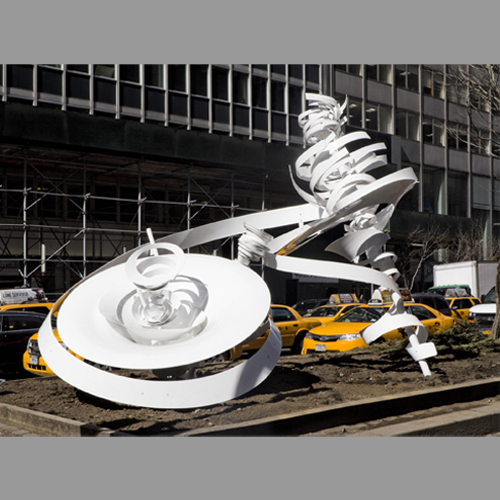
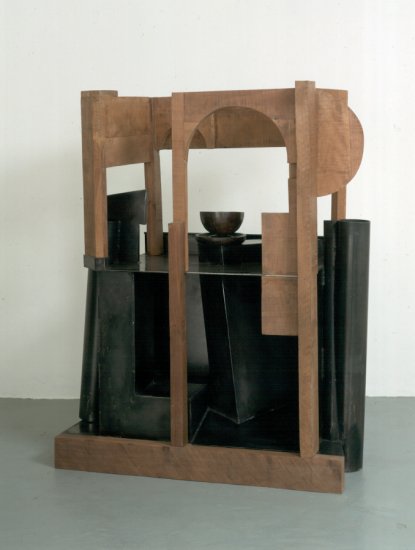
Alice Aycock                                     Anthony Caro
"Twin Vortexes"                               "Duccio Variations No 1"

The collective consideration is that it needs to allow for all of the students participating. This is already meaning that we need to adjust the materials we will use; the humanity aspect of shelter is making it hard for some students to see it as not figurative. So in allowing for this, we need to consider introducing less abstract elements. Tree forms, body parts (mannekins), chains, barbed wire. All of these will need to be considered in making sure we take into account manaakitanga.

We have a strong emphasis on positive and negative space,, the latter being something that could be used as active (Aycock) or passive (Caro) space. Though the Duccio Variations is not typical of Caro's work, It's a nice image in reference to shelter.

In making something work that helps incorporate a couple of our student's less abstract needs (literally two of them), we could use sheets of MDF to cut out silhouettes of forms, or shadows of figures that describe what these students feel they need.

There is also clearly a need to re-iterate what the assessment is actually all about; collaboration to make art as a cultural convention. Not being able to collaborate or see past their own needs might likewise be something I need to address for the greater good of the groups; the point of running term one like this was to break down this inability to work together that quite frankly exists within groups in the senior classes, for the good of each other. So while I must address the need for manaakitanga, I also need to restate our intentions as a class/department.

http://www.fairfaxtimes.com/article/20130320/ENTERTAINMENT/130329712&template=fairfaxTimes

Tuesday, 27 January 2015

Feedback

11. Analyse and appropriately use assessment information, which has been gathered formally and informally (from RTC)

i. analyse assessment information to identify progress and ongoing learning needs of ākonga
ii. use assessment information to give regular and ongoing feedback to guide and support further learning
iii. analyse assessment information to reflect on and evaluate the effectiveness of the teaching
iv. communicate assessment and achievement information to relevant members of the learning community
v. foster involvement of whānau in the collection and use of information about the learning of ākonga


So reflecting on Monday's Professional learning, we worked on understanding how to make feedback meaningful. What is useful and going to be cognitive and what is empty. "weak effort..." doesn’t help. It tells the student nothing about how they could master a new skill, improve technique or help to improve the student's general confidence. 
We used a reading from Carol Ann Tomlinson (Educational Leadership VOL. 71 No. 6 March 2014). The reading was broken into three parts and we worked through it as a jigsaw activity, learning from experts from each of the other two groups as well as teaching the other two experts also. It did make it more interesting as a process and was far preferable to sitting and being talked to for yet another hour. 
The youtube link above is Rita Pierson who is/was an American educationalist.  Great messages and she is damn funny. 
The key points of the session were:
1) How to help students understand what feedback is for; traditionally students see it as a test, which equals a grade and therefore discouragement
2) How to use clear KUD's (Knowledge, Understand, Do)
3) Making Room for student differences; allowing for alternative methods of recording evidence based on KUD's
4) Providing instructive feedback; not judgemental, even though it is a judgement (one is looking for negative aspects, one is evaluating) not empty and hard to decipher such as "weak effort" how is a student meant to interpret that? It should also provide learning targets and uses exemplars and allows for follow-up chances to apply the feedback and actually learn.
5) How to make it user friendly; this requires that the teacher understands the learning progression themselves (make an exemplar, know the pitfalls of your tasks) and is cognitive not emotional, challenging but achievable, differentiated,  and provides a "next step' to improve.
6) Assessing persistently; feedback should permeate the lesson, you are assessing confidence and also creating confidence. it should be well-structured and connected forwards and backwards from the last lesson and to the next one. The teacher should be listening for clues of understanding constantly. 
7) Engaging students with formative assessment; you want them to be engaged in the assessment process discursively. Using rubrics and 'next steps’ is important. Use exemplars, use peer assessment which needs to be explicitly taught to them. Students should be able to examine their own learning progression. 
8) Looking for Patterns; plan and group according to students needs. Plan how to move groups forward.
9) Planning instruction around content requirements and student needs; modify teaching and learning plans as required for your students as you move forward. Differentiate according to those needs.
10) Repeating the process; Habitual, ongoing repeated use of feedback and the processes developed around making sure it permeates your lesson. 
This is stuff that we all I know, I think, but sometimes having it put back at you as a well-analysed and thought out structure makes you challenge yourself as to whether you are really and consistently doing it as well as you could. 

Monday, 19 January 2015

Showing a Commitment to the Bi-cultural Partnership in Aotearoa New Zealand

The Treaty of Waitangi


  •  Respect for the heritages, languages and cultures of both partners to the Treaty of Waitangi 
How is this relevant in my Art teaching practice;

I do often feel like when I am given a form to tick off for appraisal, that when I get to this section, are they asking me if I can say the Maori students names clearly and reasonably correctly? Who is planning on trying to prove there is more to it in my subject area? It's a little bit frustrating that we are essentially founded on this document as a nation and resultingly, as a culture, yet an acknowledgement of this document is something more like lip service. I am almost certain that people I have held in esteem in the past of my teaching career have all but encouraged this without necessarily meaning to offend. 

I find the wording does allow for that; '...respect for...' sort of allows you to ignore that there are two cultures here, if you don't want to personally allow it into your practice; '...it's not really that relevant to [topic] right now...' but the title of the criteria is to "Show commitment to...". The title is strong, the explanatory note is not. It allows for a weakness in holding us accountable to the Treaty.

This is also not about the fact that the right here and now of New Zealand is a multi-cultural here and now. It is about the founding document of the here and now and honouring this meaningfully. 

"...unlike many other countries, New Zealand does not have a constitution in the form of a single document. It has a collection of common laws, customs and legislation that establish the framework of government. The Treaty was the initial agreement that established British authority. This authority was later transferred to the New Zealand Parliament..." from http://www.nzhistory.net.nz/ 

So now, I think I will leave this particular post as a work in progress, on which I will add further evidence as to how I think this is expressed in my current practice. I don't want to create a separate page for it, as it is only one of several criteria we are expected to meet as professional teachers, and I have not done that for other criteria.


Thursday, 4 December 2014

9SK Printmaking - being resilient about our mistakes

So, Art students are shocking for this; make a mistake once, HATE the whole page, screw the page up, hide it from the teacher. Deny they have learn't anything, try again, miniscule mistake no one else can see, screw it up AGAIN, 25 minutes later, it's like they have spent half a lesson doing nothing...except they haven't. When you ask casually, they "can't do it, its way too hard..." and your help is apparently not going to remedy this, unless of course you feel like completing the work for them, so that it looks 'perfect'.

Our values are Commitment, Achievement, Resilience and Respect.

Respect is easy to teach, achievement is generally an outcome and you can get there, commitment depends on the context as to how hard it can be to explicitly manage, resilience is the hardest; that pushing past a lack of confidence.

Wednesday - we have run out of time to finish this unit the way I would like to - our final resolution is a mono-print as opposed to a woodcut print. Students have worked through a process to achieve a stylised form, learning from two examples and comparing them - Art Nouveau and Kowhaiwhai. They have lovely drawings. The rule for this lesson, was everything they stuffed up we kept. Everything they got right we kept. The expectation was that they HAD to stuff it up at least twice, and they had to try and rework a 'mistake' to make something interesting from it.

Below are the examples from this class

We will complete this tomorrow, with the students who don't have their ISLA reward.