Showing posts with label #effectiveteaching. Show all posts

Saturday, 18 August 2018

Writing Big Ideas in planning units of work Incorporating LCS and SOLO

Embedding stuff that we want to use because we know it makes pedagogical sense, is easily said, but how do we do it cohesively?

1) Present a format that all departments can easily use to write units of work and/or schemes for the year in a predefined course.

2) Present a way of thinking and writing 'Big ideas' and then 'specific learning outcomes', followed by essential questions and a success criteria within, that allows teachers to easily digest and re-invent their own content and teaching methods as embedded within your chosen pedagogies.

How do we write nice clear Big Ideas for our students? When we break it up it's your overall Learning Outcome, the one that holds it all together and directs your 'why' (Sinek). It's 1) a noun or thing, 2) a measurement system like blooms (but why not SOLO? - http://pamhook.com/), 3) a verb that makes the noun or thing observable and therefore measurable and 4) any additional criteria that can be added to show the success for the student. I initially pulled something similar to this out of my very, very old lesson and unit planning booklet from 1999 at Christchurch College of Education, but found it more carefully explained and elaborated upon here: https://teachonline.asu.edu/2012/07/writing-measurable-learning-objectives/ 

From there, explicitly identifying LCS within the learning sequence in reference to SOLO could, in fact, come together nicely for us all.

If I play with this for myself, I often rely on "the role of the artist in understanding Pasifika patterns as a narrative..." as it feels broad enough to cover everything! But it is not very detail orientated, nor does it reference any pedagogy we are currently trying to use. If I apply this model it looks more like:

With SOLO referenced as a measurement:
The role of the Artist in using and extending a narrative with Samoan patterns in planning a painting.

With LCS referenced, specifically C:
The role of the artist in creating and extending a narrative with Samoan patterns in planning a painting

with LCS referenced, specifically L and C:
The role of the artist in activating your own understanding in creating and extending a narrative for the purposes of planning a painting using traditional Samoan patterns with a narrative

With reference to LCS:
The role of the artist; activating your own understanding of Samoan patterns in creating and extending a narrative through planning a painting for the purposes of exhibiting and explaining your story to others.

The role of the artist; - SOLO steps 1 and 2 Pre-structural and uni-structural
activating your own understanding of Samoan patterns  SOLO step 3- multi-structural
narrative through planning a painting  SOLO step 4 relational
understanding extending, Exhibiting and Explaining SOLO step 5 extend ideas


Activating - Learn
Creating, Understanding,  Extending, Through planning a painting - Create
Exhibiting and Explaining - Share new understandings

The role of the artist; activating your own understanding of Samoan patterns in creating and extending a narrative through planning a painting for the purposes of exhibiting and explaining your story to others.

From here devising your success criteria, or specific learning outcomes, flow forward nicely. the wording needs attention, but the idea of how I get there appears to work and is there. 


Sunday, 7 August 2016

"Write That Essay" PLD day notes

Our focus is writing and based on the Woolf Fisher data we received on Wednesday, That is pretty much what it should be.


There were a lot of useful tips and tricks that we can implement starting Monday, and we will. Blog posts are about to change for our senior students.

Monday, 1 August 2016

Language Accessibility Again

DI***********.jpgWhat worked DI.jpgUse artist model DI.jpgAnnotations DI.jpgDI************.jpgDI**************.jpgMeaning DI.jpgBeauty in your mistakes DI.jpgDI*******************.jpgDI*****************.jpg

From this,


to this...


This does work, but, man, the language is hard in the CI and UC strands for them. A lot of repetition is needed. And some definitions still need tweaking.

Not all of the words are straight from the curriculum statements. In each strand I have included words I teach to, and have taught to. For example 'Tache' in PK.

Next steps; 
- Starting at a level below what I think they are
- Building up a cache of language google drawings that they 'get' quickly and can start to show some fluency in,
- Applying the words to their own and others pieces of Art pieces and building a communal bank.
- Making this accessible to other teachers to start using and add to.
- Measuring student's performance from starting to finishing and within curriculum work over the year. Using self-assessment as well as teacher based assessment.
- How does this link into SOLO and how I am re-structuring units of work around Learn, Create, Share.

Tuesday, 28 June 2016

google drawing card for analysis and why it didnt work

Language. If you don't have it, you can't apply it. Interestingly, as I explained the concepts, it clicked into place, but I still had to keep doing this and in the ned, I really just made  a bunch of kids "repeat after me..."

What I have I learned?
1) they are clever enough there is not deficit with their intellect.
2) It doesn't matter if you are clever, if no one has exposed you to the language to express it
3) All of this correlates to our data on writing.


Shikobi tells me it was alright, but why were my words so confusing?


Next steps:
Go back to language base, and develop it based on breaking down and analysing the curriculum levels. This will be an interesting exercise as I don't think it has been done. If so, there are no easily available resources on it. How would a general teacher expected to cover all subjects at junior levels be expected to manage this? Not cool, TKI!

I used to use flash card, which worked (i love organising things by colour) but were easily lost, not something they could take home and laborious to make a student copy for, let along keep up on maintaining full sets int eh right colours. How to do this digitally.

Also, I want to use a small group of kids that I can take out of a class and work with as opposed to relying on my own art time.

Monday, 16 May 2016

SOLO in Art

This is our take on SOLO with Visual Arts. It fits cleanly with our base assessment scale, with the expectations of NCEA in visual Arts at level 1 - 3 and as a way to enable good clear scaffolding for students to achieve at higher levels too.


What Is My Innovation?

Trying to get to the point where students can identify what they are doing and why they are doing it. But also being brave enough to share how they are doing, without fear

Have I explicitly taught the strands? No. Is this a mistake? Possibly.

I consistently address that fear of people seeing whether or not the students are 'good enough'. I am so caught up with my junior classes teaching in the limited time that we have, that unpacking the strands, can be something that gets put 'away'.

SOLO - we did this once! We had extensive PLD on it and then it fell away with the numerous other commitments we have. I am wondering how I explicitly re-introduce this and link to this as well as make those strands more obvious, student owned. When I took on SOLO in Art, I added in an extra step. When SOLO is related to NCEA 'achieved', 'merit' and 'excellence', multi-structural comes out as 'achieved'. I feel that is inaccurate at level one NCEA. So we added in another step. in order to get 'achieved' we rely on relational as the step that correlates. I will post separately on this to explain this further.

The term one focus for us with the outreach programme has been rewindable learning. The google site, with the teaching blogs has been a way of keeping learning available and rewindable. This has to aide in helping students develop their understanding of the work, but not necessarily the base strands that work applies to.

So the google sheet design collecting students self-assessment actually becomes less of an innovation and more of a data collection as to how well students manage putting their own thoughts about learning out there as data and whether or not they understand our teaching and how it all works. How do students feel about making their own thoughts on their grades visible? Do they understand what is expected of them?

Because the students have not designed the google sheet with me - i.e. they have to understand the criteria for each task, but I am using language they don't get, they do not yet own it. We have reworded lots of it already.


Challenges:
- Time in the classroom - we lose a lot of time in 7 and 8 for Kiwican, sports, teacher conferences, attitude talks, assemblies...
- Access to devices - this can be cumbersome when not all students have them. Locating spare ones takes time and energy and at times guess work.
- Is this relevant to actually making what I am trying to ultimately achieve?
- Have I extended myself too far?

Next steps:
- Focus on one class only. Not all.
- Take time out of the curriculum intentionally with this one class. 7 Bk - as they have already lost a lot of content time so maybe they are a class to work with. Because the content is lacking, then I can already safely afford to determine that understanding process is more important? They can make up for their lack of content by understanding the curriculum better and being able to articulate it and therefore progress almost as quickly upwards because of their more implicit understanding.
- Clarify SOLO for Visual Arts at Hornby.
- Create an exemplar of processing work into curriculum strands.
- Create basic definitions of each strand, set it up as a group exercise where students categorise and process an art assignment into the strands. This can be the work we have already done or work from other years.

Because I only have this class once a week, it could be that every lesson for 15 minutes we do this. I teach a refined programme to this class that could help back up the strand focussed on, or not.

Working using Google Draw, I have an idea of how to create a 'make a copy' file way of doing this.


SAMR - Not a Hierarchy

Above the line and below the line is often how it is referred as, but as soon as you do that, it becomes something that has a finish - when you get to redefinition, you can go no further until someone invents a new app...

This approach negates the fact that there is good teaching and bad teaching, good learning, bad learning with or without technology. Sometimes a substitution task is the most appropriate for the learner in front of you. Sometimes you move from redefining a task back down to substituting a section of it with a google doc, for good reason; the best for the learner's needs at the time.

While what we want is for students to be determining their own learning, that is not always possible, nor what we need at the time. The idea that if we are teaching to the needs, and students are learning what the need to know, we are moving above and below the line all the time.


Wednesday, 11 May 2016

Student self assessment - Qualitative Data gathering using google sheets

Spark - MIT have given me the opportunity to explore and figure out a way of developing a way with my students to unpack the curriculum in Visual Arts for themselves. In order to do this successfully, (shoutout Tania Coutts for help with this) I need them to be able to not only self assess, which they do anyway, but to be public and brave about it.

Google sheets is essentially 'live'. 'Protected sheets and ranges' means that I can have multiple editors and lock them down to only what I want them to be able to edit. Qualitative data is significant in understanding how students are managing that top end of the curriculum.

This is where we are at with all of our junior classes. Because it is all of them (13 classes in all) it is a bit of a Himalayan trek to get it all done.


This is a screen shot from one class who are incomplete so far.
Each student can only access their own row. It is colour coded and is my marking schedule anyway for the class, with alterations made to the language, as they tell me some of my criteria were too confusing... They can see what each other are entering right then and there and this can be good or bad. How I manage the culture, as the teacher running the task at the time, is important here. It does take clear explanation first as well.
We are working on refining it with each class and there is differing feedback from each class. So it has to be developed with the class, not for the school.

Sunday, 21 February 2016

MIT Manaiakalani Innovative Teacher's Scholarship 2016

This is something I applied for in 2015 as something to address in imbalance that exists in getting talented, priority learner Art students through into NCEA with as much confidence in the written/analytical strands of the curriculum, as well as handling the visual/technique based strands.

I want to create an online exemplar forum of student work that is live and demonstrates the curriculum at the junior levels as low mid and high. we are moving to reporting to our community along these lines, as a lot of schools already do, and even using NCEA terminology of Achieved, Merit and Excellence within each level. Years' 9 and 10 are my target group at the moment.

Writing and literacy is a major focus for our school and this inquiry I have planned addresses that focus in Art as well as working at making digital learning opportunities ubiquitous and moving critique and self-assessment into the modification and redefinition phase of SAMR (Substitution, Augmentation, Modification, Redefinition)

Rough Breakdown Of the Visual Arts Curriculum:

PK - Practical knowledge - at ALL curriculum levels this is technique/technical based learning in Art
DI - Developing ideas - likewise all levels, it is about formulating ideas to make your own art works happen and showing thought in doing so.
UC - Understanding Context - that art works are viewed and/or made
CI - Communicating and interpreting about your own and other's art works

The top two do in fact require a very good level of literacy at all levels to generally excel at them, however, you can to a certain extent do really well without this, as thinking can be so very visual too. But I feel it hinders not having that literacy.

The bottom two strands are most easily assessable (but I wonder if that means not necessarily understandable) with good literacy.

The order I have listed these strands is how they were initially released when the Visual Arts curriculum was released in the year 2000. However, when it was revised in 2008, the order was changed to have UC, PK, DI and CI as the order. While that may seem like not terribly important, it was a way of trying to get teachers to focus on making sure students understood the context of what they were studying. Hence making the emphasis a little more important that the students have higher levels of literacy, in order to truly manage the higher levels of the curriculum (NCEA).

Each year, there are students in our classes who are highly skilled visually, but are sitting much lower than you would want, with literacy. It is at every level. There are students who despite this, have been known at achieve University Entrance level in their chosen field of Art and I could rattle off a few dozen names from memory (not doing that on the public web though!). Equally there are just as many who don't make that level and it often appears, or can be explained by literacy levels.

There has been a clearer distinction for me lately - students who have participated in critique, even with low literacy levels, manage to eventually get to the level required, even though their language skills were less evident. Though this is often at the expense of the teacher's time and other teaching opportunities. More frequently, we have good examples of student learning and end achievement in the senior levels from students who not only participated in the group critiques, but also blogged about their work, in their own language, were more likely to succeed. I am not giving numbers here. My numbers are too low to use as statistics with any real integrity. I had 1 photography student at level 3 in 2015. So that is 100% pass rate. Really, that is not a good way to report statistics. My 3 painters gave me stats of 66% merit endorsement, 33% achieved grades and in total, obviously 100% pass rate. So clearly, I am amazing. Or the numbers are just too low to read as statistics. Those stats also don't show the students I lose leading up to level 3, and those the school itself loses before I could even possibly get them into a level 3 class. Again, lies and statistics.

That throws up the other issue that I am using this to also track and hopefully positively impact retention into NCEA courses here at Hornby High School as well as provide a real resource that other teachers can key into, students can access ubiquitously and use at their own pace to measure, target and improve their own learning. They will also be able to take their own work and share it as a valid, real, teaching and learning resource.


Sunday, 6 September 2015

Creating Agentic Learners

Agentic is a funny word that my husband tells me makes little sense. Agentic = agency = bad place to have to go to, someone there telling you off, making you beg, judging your values...a social welfare institution looking over your shoulder. It is generally a negative connotation.

I find this a funny word, but what it is meant to mean here is being the agents of your own destiny, being in control of your own learning. It is something that our school documents talk about a lot, in creating resilient learners. Resilience being one of our core values, CARR values.

It is really easy to fall into a trap of doing too much for you learners. When you see them struggling to even get some containers organised for taking paint home (one student so far out of 25 year 11's); my first thought is to go down to the warehouse and get some for them. It's only a few dollars, some students may not have a few dollars, I feel like I am letting them down not doing this. But then, is this a case of priorities and/or lack of lateral thought on how to solve the problem themselves. Do I set it up so that thought doesn't go into how to get around the problem, next time something is needed? Sometimes I think yes, sometimes no. I think it all depends on the context. But I am not buying those containers for my senior students! I do think it is not encouraging agency to just buy them.

This is my "hunch"; that I can increase the levels of agency in my senior students by expecting them to make some important decisions about their work and expecting them to find solutions that I do not provide for gear.

This is how I have been doing this so far: Year 11 - nothing about their folios is pre-formatted. While they have an overarching theme of Propaganda and world war two, they are expected to develop their own approach to it. Normally I would encourage this, but also have significant scaffolding to fall back on for students who were likely to struggle. The problem being, that capable students would also fall back on the scaffolding, as it was easier. So they are not extending themselves. Their work falls a little bit flat sometimes. So I have reversed that. Students are expected to develop their own way forward, and if I recognise the struggle, which I should with all the checks and balances in place, I work on scaffolding the work to the individual. This is not necessarily easy to do with a large class, and it more like the approach I take at Year 12, with smaller numbers.

Progress with this class so far is interesting. There are students who are doing really cool stuff; Liberty, Theresa, Madison, Shane, Taryn, Olivia, Tailah, Jahaana, Shaiana all showing a sense of control over their own ideas, telling me what they think their next step is, and why, with good back up. There are nine students also struggling. One is due to skills not being in balance with ideas. Four are because they speak little English, and struggle with following what is going on. The remaining four sit with lower literacy levels than you would want in Year 11.

A breakdown statistically:

  • Students excelling - 9, 8 girls, 1 boy. 4 Maori students, 4 Pakeha
  • Students struggling: 9, 4 girls, 4 boys, 2 Maori, 2 Asian, 1 Middle Eastern, 1 Pasifika, 1 Pakeha.
  • In-between: 7, 6 girls, 1 boy, 1 Maori, 6 Pakeha.
What to do about ensuring full success: the next two weeks are about structuring and scaffolding work for those students who are in that bottom group. But, I feel like this has to be done in a way that allows for 'agency'. So that means framing up a direction that each student could take, but allowing for choice, and finality. e.g. 'Do two A3 paintings, that fit here, choose between these three themes, then design the top half of panel two based on what you think is the next step'. That, I have rattled off as an example of how I would potentially speak to one student in particular, who is in my head as a write.


Beyond that, I do not want to leave that top group alone, I want to push the extension required too. Critiques could be a way of doing this, which could encompass that in-between group, providing momentum and possible extension too.  Critiques in fact could be my inquiry focus for Year 11 in general. Critiques in groups, self-managed by the students, not me, as a means of extension and agency. My hunch again; that introducing critiques in small groups without teacher input, but with expert learners, could also encourage agency.


Tuesday, 10 March 2015

Developing Resilience continued...

Last year, I started thinking about how resilience could be addressed in a more explicit manner in my classes. As one of our school values, it is obviously something we as staff here feel is needed to be boosted. I heard something on the radio on the way to school the other morning about how 'Human Resources' teams in big companies assess potential employees' "RQ" or resilience quotient. I don't know if that is true! Half way through writing I just did an internet search and there is definitions and a website on which you can test your Resilience Quotient. There are PDF forms and online forms you can use to be tested.

I have become a little more sensitised to this, having an intern (student teacher) from NZGSE with me this term. She has noted, strikingly in her opinion, how quickly a high proportion of students give up, rate themselves as rubbish, and are not resilient. This is something that though I'm aware of, I think it has become something I take for granted - my awareness of it, that is. I know it, I don't fully accept and I do actively work on it, like it is just something to work on, as that is what it is for me. And it is for everyone who teaches here. It is why we have resilience as an explicit value. It worries me that I could become so used to it, that I don't take the time to care about raising it up in my classroom.

So last year, in SK we did the mono-prints, and I wouldn't let them throw them out, even if they hated them. For the last 3 years, my first project with year 10 students has been all about not hiding your mistakes, but making something more of them - "beauty in your mistakes" was one year, and this year it has been our learning outcome of  'making your mistakes your intentions'. Going with the flow, and adapting an attitude of  'oh dear, the ink went there, how do I make that work for me?'

1.2 - Level one: At Year 11 we have been making sure they don't have enough time to even acknowledge them in the learning process; Nicole (intern) and I were both first year fine arts doing similar programmes. Life drawing was a pretty normal part of this. You do 3 hours of drawing in one session, once a week. For me, it was a compulsory aspect that you had to pass to graduate onto level two. So, your first half hour is warm up drawings 30 second poses, followed by 2 minute poses, then something like 10 minutes, leading up to 30 mins or an hour or more, depending on how your teacher felt at the time. Always you would start with 30 seconds. So did we. We took the chairs away (locked them out the back), encouraged gestural drawing and set a timer:


These are a few of the more finished ones so far. We gave them more time on this, but at a certain level, they are losing some of the fluency they were achieving.


Students created a good 10 - 20 pages of drawing each, and because they were drawing so fast and changing papers without reflecting on them, looking for flaws, they had no choice but to develop a sense of fluency that they would have been too scared to do, if we had let them just meander their way through the three lessons that they did this for. It does mean a lot of unfinished drawings, but we are hoping that there is still enough honest evidence of fluency (excellence) or control (merit) in most, as there is definitely enough base recording information (achieved). I'm really proud of these drawings and of how seriously this lovely class have been taking themselves. We even had one of our students, who messed up with her  personal management (taking time off class, knowing she should not have) asking if she could work through the 30 second drawings by herself to catch up. While it's harder to be successful without the classroom momentum, it showed she was doing something resilient. Progress!

Monday, 23 February 2015

Using Assemblage Sculpture as a Cultural Convention and Communal Art Work

So I went to this whole day presentation by the Manaia Kalani group pitching to our school cluster to be an outreach programme. There were parts that I really enjoyed in relation to my classroom practice with little reference to elearning.

One part was that of a breakdown of how the Treaty can be viewed in relation to good practice. A break down;

Manaakitanga - is a collective consideration, derived from the word 'Mana'. Mana being the prestigious holding of power and authority whilst in service of others.

Rangatiratanga - collective control, the application of Mana.

So in my previous struggle to figure out how the Treaty of Waitangi can be made a little bit more meaningful in how we do what we do and why, I feel like this suddenly helps me see the links in using relational practice, discursive practice and how it all fits together in Modern Learning Pedagogy.

At year 12 and 13, we are working towards creating a communal sculpture assemblage-based. Our issue is shelter, our media is found materials, our intention is to create a base muse that students can work from as a muse in drawing out their folio concept.


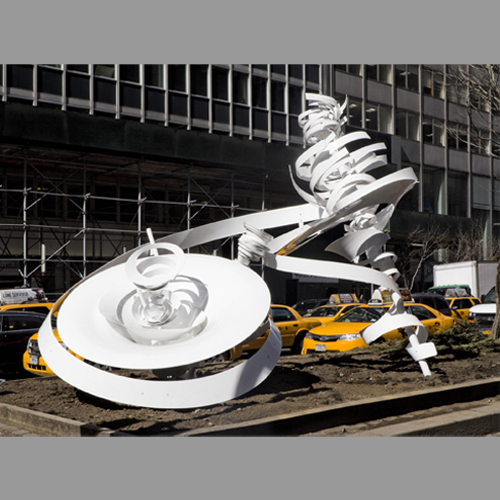
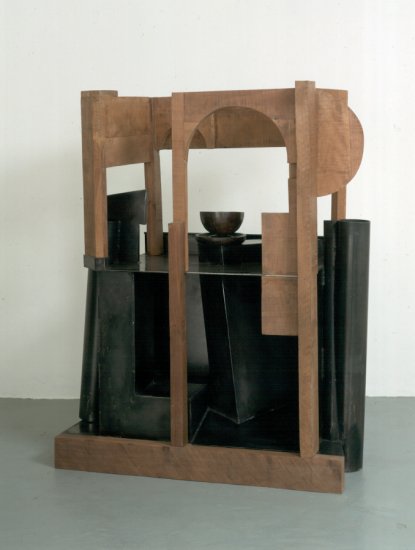
Alice Aycock                                     Anthony Caro
"Twin Vortexes"                               "Duccio Variations No 1"

The collective consideration is that it needs to allow for all of the students participating. This is already meaning that we need to adjust the materials we will use; the humanity aspect of shelter is making it hard for some students to see it as not figurative. So in allowing for this, we need to consider introducing less abstract elements. Tree forms, body parts (mannekins), chains, barbed wire. All of these will need to be considered in making sure we take into account manaakitanga.

We have a strong emphasis on positive and negative space,, the latter being something that could be used as active (Aycock) or passive (Caro) space. Though the Duccio Variations is not typical of Caro's work, It's a nice image in reference to shelter.

In making something work that helps incorporate a couple of our student's less abstract needs (literally two of them), we could use sheets of MDF to cut out silhouettes of forms, or shadows of figures that describe what these students feel they need.

There is also clearly a need to re-iterate what the assessment is actually all about; collaboration to make art as a cultural convention. Not being able to collaborate or see past their own needs might likewise be something I need to address for the greater good of the groups; the point of running term one like this was to break down this inability to work together that quite frankly exists within groups in the senior classes, for the good of each other. So while I must address the need for manaakitanga, I also need to restate our intentions as a class/department.

http://www.fairfaxtimes.com/article/20130320/ENTERTAINMENT/130329712&template=fairfaxTimes